Standardize Palletizing with One Interface Across Projects
Standardize Palletizing with One Interface Across Projects
One palletizing interface for every deployment.
Deploy mixed-case and single-SKU palletizing systems using a consistent interface — reducing project-to-project variation, simplifying commissioning, and lowering long-term support and training costs across customer sites.
What's Broken Today

Every palletizing project reinvents the interface
Across projects, palletizing HMIs are often rebuilt from scratch or heavily customized. Button layouts, fault messages, recovery flows, and configuration screens vary by customer, site, and engineer — increasing complexity with every deployment.

Inconsistent interfaces increase commissioning and support effort
When interfaces differ from one project to the next, commissioning teams spend valuable onsite time re-learning controls and validating edge cases. After go-live, support teams struggle to diagnose issues quickly because behavior and terminology are not standardized.

Knowledge stays locked to a few engineers
Operational nuance — how to recover from faults, how to handle exceptions, how to adjust pallet behavior — often lives in the heads of experienced engineers. As teams scale, this creates bottlenecks, training challenges, and risk when key individuals are unavailable.
With the OmniPalletizer
Modern palletizing systems no longer need to be defined by custom logic and bespoke interfaces.
Instead of rebuilding controls and workflows for every project, integrators can now deploy a consistent palletizing interface that reflects how intelligent palletizing systems actually operate — adapting to variability while guiding operators clearly when human input is required.
This allows integrators to standardize the palletizing experience without sacrificing flexibility for different customers, layouts, or industries.

How the OmniPalletizer Solves It
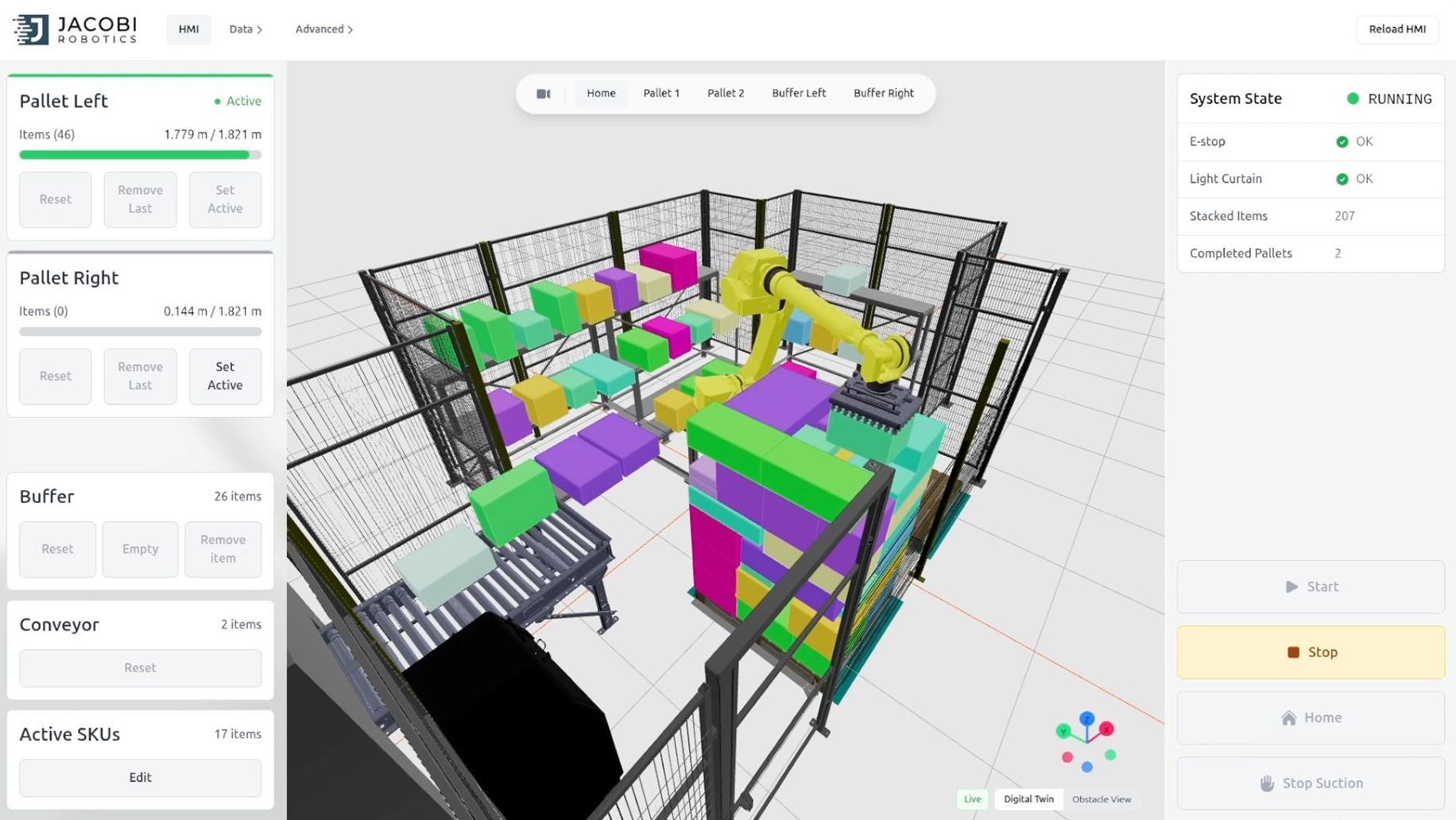
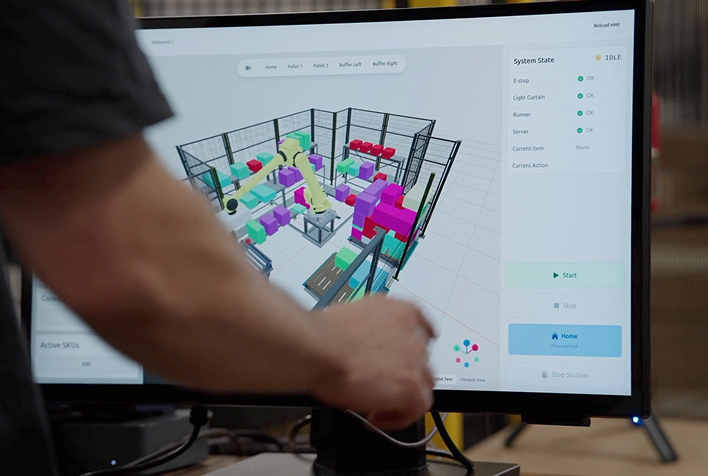
Jacobi's OmniPalletizer provides a unified palletizing interface designed to scale across projects.
It enables integrators to:
Deploy a consistent operator and engineer workflow across mixed-case and single-SKU palletizing cells
Standardize fault handling, recovery steps, and operator prompts for predictable behavior onsite
Configure palletizing behavior through software settings instead of custom HMI logic
Reduce commissioning time by reusing familiar controls and workflows
Train operators and support teams once — and reuse that knowledge across deployments
The same interface philosophy applies whether the cell handles inbound palletizing, grocery, LTL, or store-ready pallets.
Business Impact
Faster commissioning through reuse of familiar interfaces and workflows
Lower long-term support and maintenance burden
Reduced dependence on individual engineers’ tribal knowledge
More predictable operator experience across customer sites
Scalable palletizing deployments without scaling interface complexity
The New Standard for Palletizing
OmniPalletizer becomes a standard palletizing interface — one that can be deployed repeatedly across customers and projects.
Instead of delivering a different palletizing experience every time, integrators can focus on system design and value engineering, knowing that operators, support teams, and engineers will interact with a familiar, proven interface on every deployment.